


Case Study:
Nostalgia
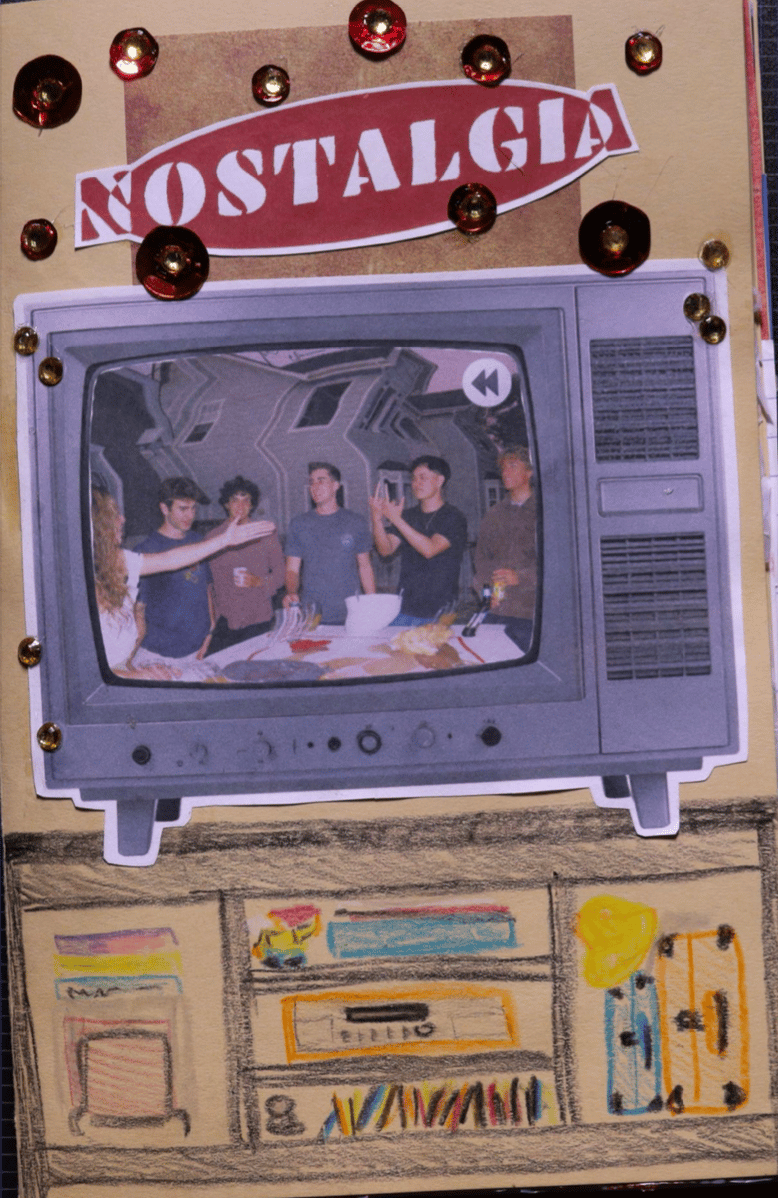
Zines live and die by their ability to feel like they were made for someone. Nostalgia needed to function as both a personal archive and a piece of writing worth reading by strangers.
Every spread was built around a central tension: the warmth of looking back versus the uncertainty of moving forward. Rather than resolving that tension, the zine leans into it. Content ranges from childhood memory to college-town geography to fashion philosophy.
Mixed media was used throughout: original drawings, candid photography, cut-and-paste collage, and handwritten annotation. The result is a publication that feels assembled rather than produced — intentionally imperfect, in the way that memory itself is.
Nostalgia was self-produced as a perzine: a personal zine authored, designed, and assembled entirely by one creator. Spreads were composed by hand and photographed, with typography set in a typewriter-style font to echo the DIY print tradition.
A 17-page document of late college life that reads like a scrapbook but argues like an essay. Nostalgia demonstrates that personal writing, when committed to a clear aesthetic and an honest point of view, can reach beyond its original audience.


Case Study:
Nostalgia
Zines live and die by their ability to feel like they were made for someone. Nostalgia needed to function as both a personal archive and a piece of writing worth reading by strangers.
Every spread was built around a central tension: the warmth of looking back versus the uncertainty of moving forward. Rather than resolving that tension, the zine leans into it. Content ranges from childhood memory to college-town geography to fashion philosophy.
Mixed media was used throughout: original drawings, candid photography, cut-and-paste collage, and handwritten annotation. The result is a publication that feels assembled rather than produced — intentionally imperfect, in the way that memory itself is.
Nostalgia was self-produced as a perzine: a personal zine authored, designed, and assembled entirely by one creator. Spreads were composed by hand and photographed, with typography set in a typewriter-style font to echo the DIY print tradition.
A 17-page document of late college life that reads like a scrapbook but argues like an essay. Nostalgia demonstrates that personal writing, when committed to a clear aesthetic and an honest point of view, can reach beyond its original audience.
More Zine Work:

Graduation, I guess?
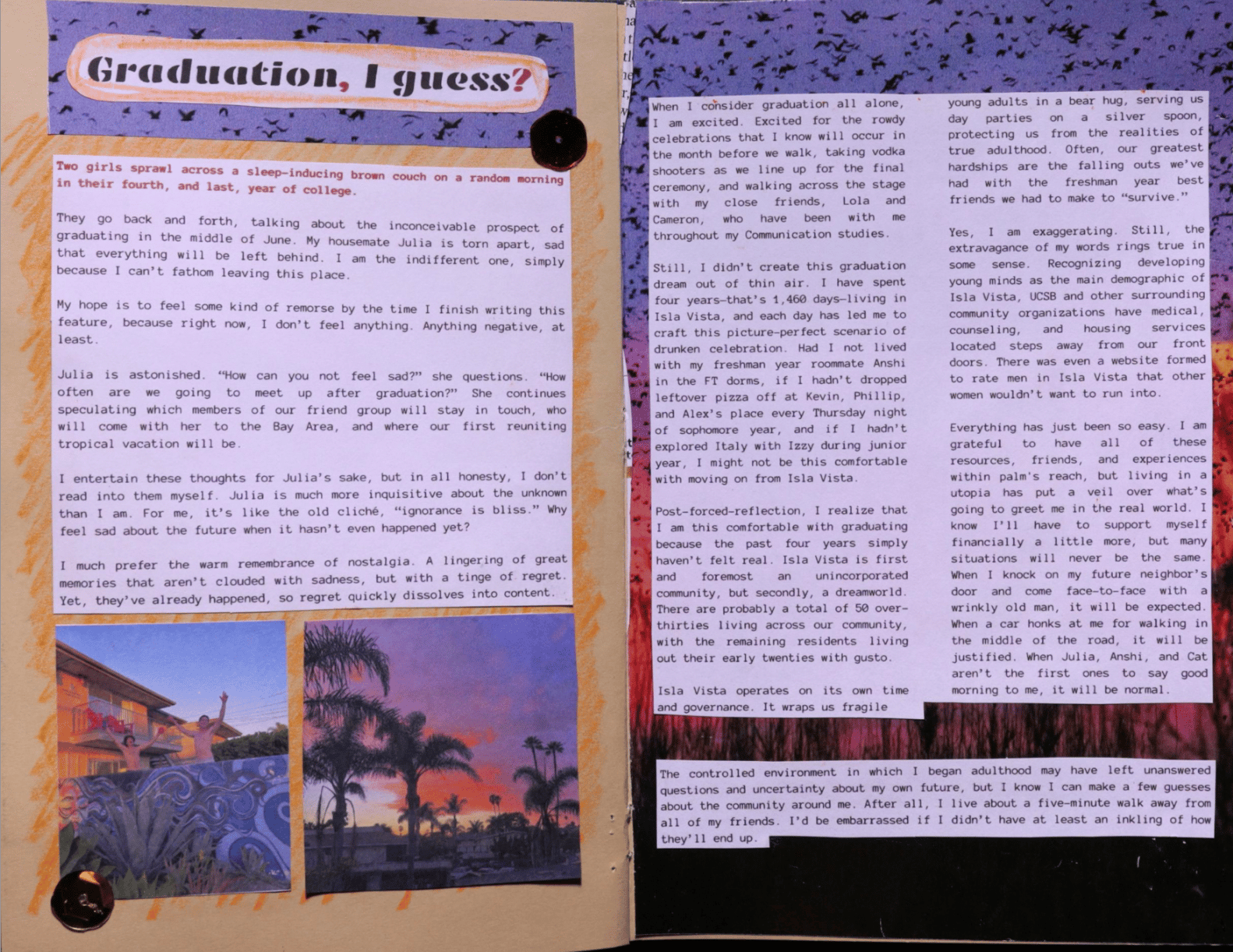
"Graduation, I Guess?" explores graduation from the outside in. Where others felt grief or fear, I felt something softer — a pull toward the past rather than anxiety about the future. The story doesn't pretend that optimism came naturally; it shows the work of arriving there, both for myself and for the friends whose paths I watched diverge.
contact me!
Case Study:
Nostalgia
Zines live and die by their ability to feel like they were made for someone. Nostalgia needed to function as both a personal archive and a piece of writing worth reading by strangers.
Every spread was built around a central tension: the warmth of looking back versus the uncertainty of moving forward. Rather than resolving that tension, the zine leans into it. Content ranges from childhood memory to college-town geography to fashion philosophy.
Mixed media was used throughout: original drawings, candid photography, cut-and-paste collage, and handwritten annotation. The result is a publication that feels assembled rather than produced — intentionally imperfect, in the way that memory itself is.
Nostalgia was self-produced as a perzine: a personal zine authored, designed, and assembled entirely by one creator. Spreads were composed by hand and photographed, with typography set in a typewriter-style font to echo the DIY print tradition.
A 17-page document of late college life that reads like a scrapbook but argues like an essay. Nostalgia demonstrates that personal writing, when committed to a clear aesthetic and an honest point of view, can reach beyond its original audience.
More Zine Work:

Graduation, I guess?
"Graduation, I Guess?" explores graduation from the outside in. Where others felt grief or fear, I felt something softer — a pull toward the past rather than anxiety about the future. The story doesn't pretend that optimism came naturally; it shows the work of arriving there, both for myself and for the friends whose paths I watched diverge.
contact me!