


Case Study:
Morality-as-Cooperation Codebook
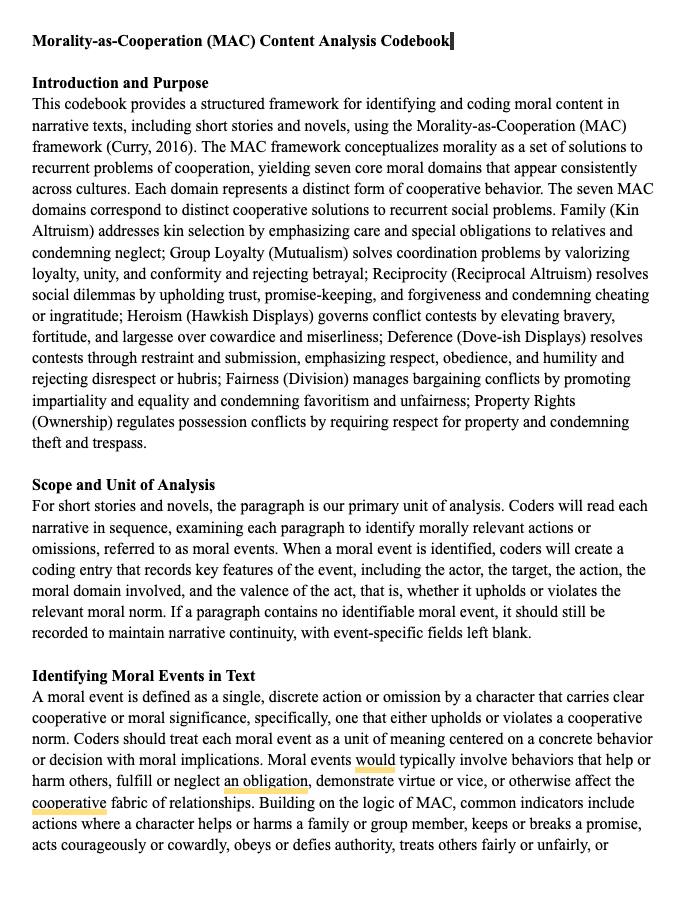
As part of a research lab focused on moral and narrative theory, the project at right required a structured framework for systematically identifying and classifying moral content across narrative texts.
The codebook is built on the Morality-as-Cooperation (MAC) framework, which treats morality as a set of evolved solutions to recurring social problems. Seven domains: Family, Group Loyalty, Reciprocity, Heroism, Deference, Fairness, and Property Rights each represent a distinct form of cooperative behavior that appears consistently across cultures. The paragraph was established as the primary unit of analysis, with each discrete moral action or omission coded as a separate event.
Each coded event captures a standardized set of fields: the actor, target, moral domain, valence score, action verb, motivation, outcome, and a supporting evidence quote. Decision heuristics were developed for each of the seven domains to guide coders through ambiguous cases, and a confidence rating system was built in to flag uncertainty and support coder reconciliation during quality review.
The completed codebook provides a replicable system for quantifying moral content in narrative media, producing data that can be used to analyze how stories distribute moral themes, which cooperative norms appear most frequently, and how valence patterns shift across a narrative arc.


Case Study:
Morality-as-Cooperation Codebook
As part of a research lab focused on moral and narrative theory, the project at right required a structured framework for systematically identifying and classifying moral content across narrative texts.
The codebook is built on the Morality-as-Cooperation (MAC) framework, which treats morality as a set of evolved solutions to recurring social problems. Seven domains: Family, Group Loyalty, Reciprocity, Heroism, Deference, Fairness, and Property Rights each represent a distinct form of cooperative behavior that appears consistently across cultures. The paragraph was established as the primary unit of analysis, with each discrete moral action or omission coded as a separate event.
Each coded event captures a standardized set of fields: the actor, target, moral domain, valence score, action verb, motivation, outcome, and a supporting evidence quote. Decision heuristics were developed for each of the seven domains to guide coders through ambiguous cases, and a confidence rating system was built in to flag uncertainty and support coder reconciliation during quality review.
The completed codebook provides a replicable system for quantifying moral content in narrative media, producing data that can be used to analyze how stories distribute moral themes, which cooperative norms appear most frequently, and how valence patterns shift across a narrative arc.
contact me!