


Case Study:
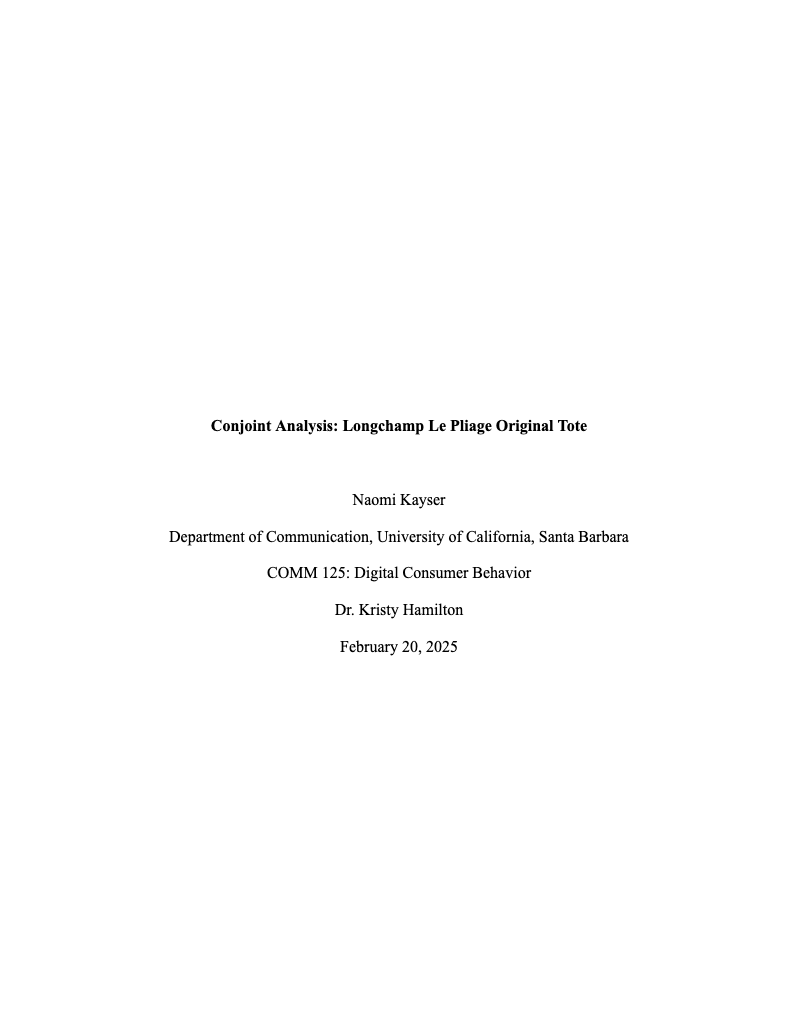
Conjoint Analysis: Longchamp Le Pliage Original Tote
For a digital consumer behavior course, I constructed a conjoint analysis on a product in the fashion industry to measure how consumers weigh individual product features against one another when making purchase decisions.
Longchamp’s Le Pliage tote was selected as the focus product, with an audience of female college students who commonly use it as a school bag. Four features were evaluated across two levels each: price ($155 vs. $255), material (waterproof vs. not), size (large vs. medium), and color (neutral vs. bright). This resulted in 16 product variations for the interview subject to rate by purchase likelihood.
A linear regression on the survey responses produced partworth percentages revealing how much weight the consumer placed on each feature; price dominated at nearly 54% of total product value. Willingness to Pay calculations then translated those percentages into dollar values, showing the consumer would pay up to $32 for a larger bag but only $23 for neutral colorways.
The analysis surfaced a practical recommendation: reducing the lowest-performing bright colorways could not only lower production costs, but also bring the bag's price closer to what the target consumer is actually willing to pay without sacrificing the features they value most.


Case Study:
Conjoint Analysis: Longchamp Le Pliage Original Tote
For a digital consumer behavior course, I constructed a conjoint analysis on a product in the fashion industry to measure how consumers weigh individual product features against one another when making purchase decisions.
Longchamp’s Le Pliage tote was selected as the focus product, with an audience of female college students who commonly use it as a school bag. Four features were evaluated across two levels each: price ($155 vs. $255), material (waterproof vs. not), size (large vs. medium), and color (neutral vs. bright). This resulted in 16 product variations for the interview subject to rate by purchase likelihood.
A linear regression on the survey responses produced partworth percentages revealing how much weight the consumer placed on each feature; price dominated at nearly 54% of total product value. Willingness to Pay calculations then translated those percentages into dollar values, showing the consumer would pay up to $32 for a larger bag but only $23 for neutral colorways.
The analysis surfaced a practical recommendation: reducing the lowest-performing bright colorways could not only lower production costs, but also bring the bag's price closer to what the target consumer is actually willing to pay without sacrificing the features they value most.
More Coursework:

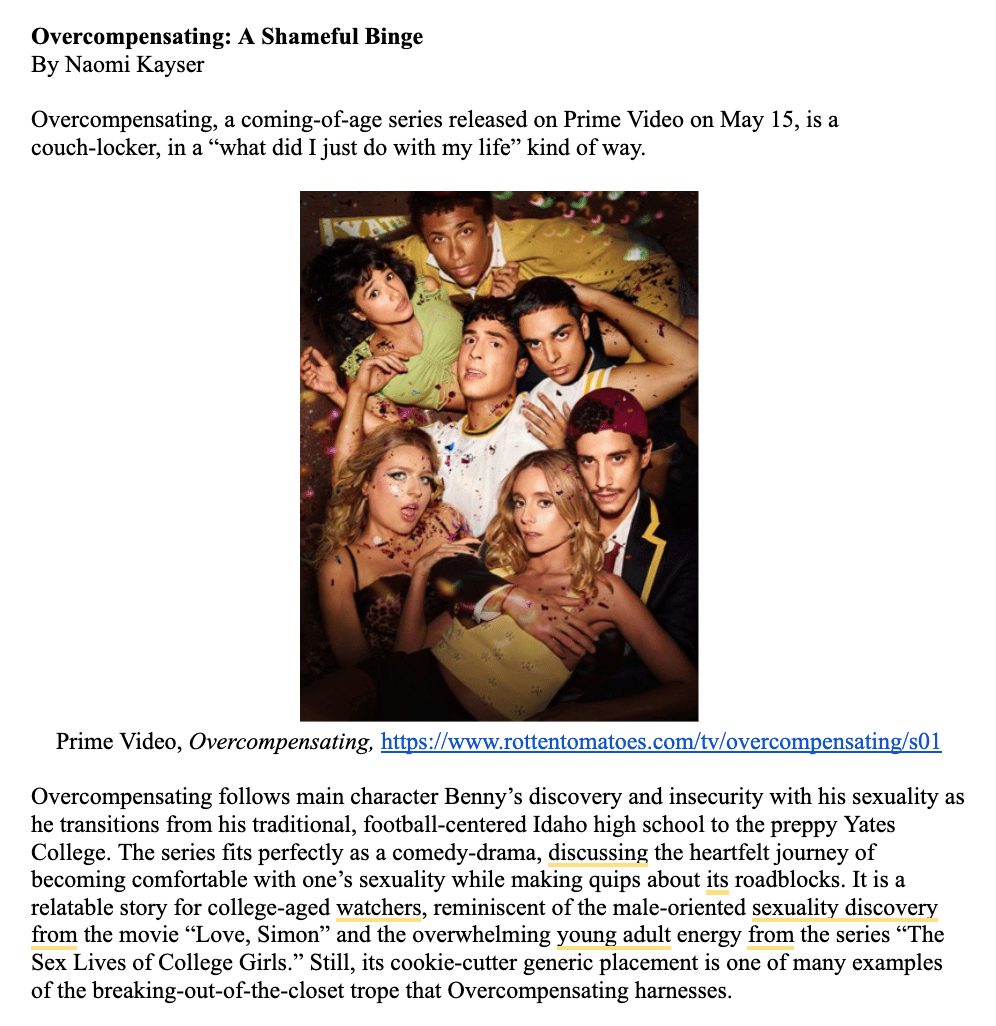
Magazine Writing, Critical Review
Written for my magazine writing class, this review of Overcompensating goes beyond surface-level critique — analyzing scene construction, casting, and dialogue to build a pointed perspective, while connecting the show to broader cultural conversations around queer young adult life.
contact me!
Case Study:
Conjoint Analysis: Longchamp Le Pliage Original Tote
For a digital consumer behavior course, I constructed a conjoint analysis on a product in the fashion industry to measure how consumers weigh individual product features against one another when making purchase decisions.
Longchamp’s Le Pliage tote was selected as the focus product, with an audience of female college students who commonly use it as a school bag. Four features were evaluated across two levels each: price ($155 vs. $255), material (waterproof vs. not), size (large vs. medium), and color (neutral vs. bright). This resulted in 16 product variations for the interview subject to rate by purchase likelihood.
A linear regression on the survey responses produced partworth percentages revealing how much weight the consumer placed on each feature; price dominated at nearly 54% of total product value. Willingness to Pay calculations then translated those percentages into dollar values, showing the consumer would pay up to $32 for a larger bag but only $23 for neutral colorways.
The analysis surfaced a practical recommendation: reducing the lowest-performing bright colorways could not only lower production costs, but also bring the bag's price closer to what the target consumer is actually willing to pay without sacrificing the features they value most.
More Coursework:

Magazine Writing, Critical Review
Written for my magazine writing class, this review of Overcompensating goes beyond surface-level critique — analyzing scene construction, casting, and dialogue to build a pointed perspective, while connecting the show to broader cultural conversations around queer young adult life.
contact me!